
Introduction: Beyond the “Caveman” Caricature
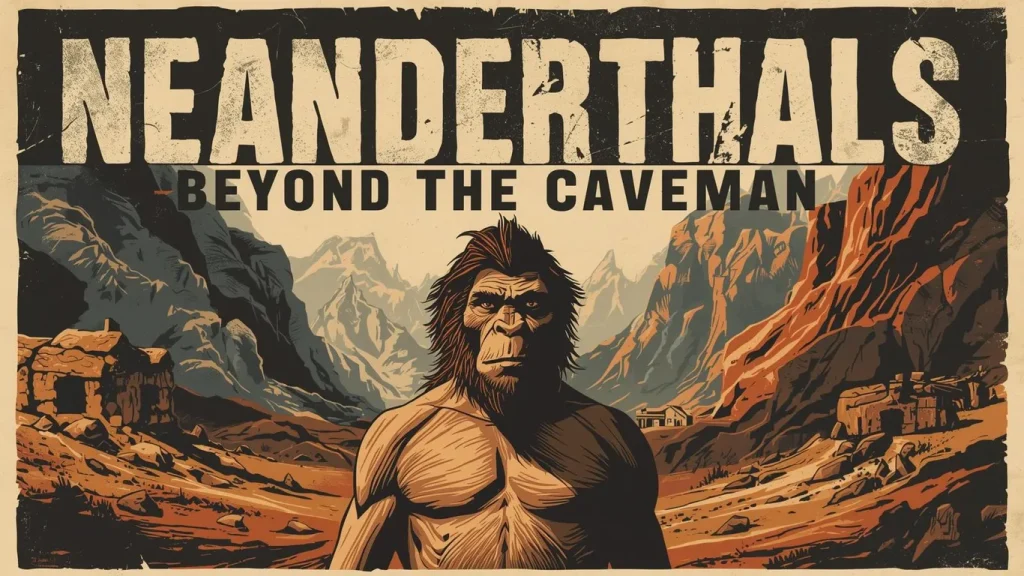
When you hear the word “Neanderthal,” what comes to mind? For many, it’s the classic caricature of a brutish, unintelligent “caveman”—a hunched, primitive figure clutching a club. But as scientific discoveries advance, this outdated image is being completely overturned. Research highlighted by experts like Professor Chris Stringer from the Natural History Museum reveals a far more complex, capable, and surprisingly human picture of our ancient relatives. Forget the stereotypes; here are five impactful discoveries that challenge our old assumptions and paint a new portrait of the Neanderthals.
1. They Had Brains Bigger Than Ours
Contrary to the “dumb brute” stereotype, Neanderthals had brains that were, on average, larger than the brains of modern humans today. The brain size of late Neanderthals ranged from at least 1,200cm³ to 1,750cm³, placing the modern average comfortably within their spectrum.
It’s important to note that this larger brain was in proportion to their generally bigger and more muscular bodies. Furthermore, early Homo sapiens living around 30,000 years ago also had larger brains on average than we do now. This suggests that a slight reduction in brain size is a more recent evolutionary trend in both human lineages, rather than a simple differentiator between “smart” modern humans and “less smart” Neanderthals. This simple anatomical fact fundamentally undermines the long-held assumption of their intellectual inferiority.
2. They Were Technologically Innovative
Neanderthal intelligence wasn’t just theoretical; it was expressed through sophisticated technology. One of the most compelling examples is the “Levallois technique,” an innovative method for crafting stone tools that they developed around 300,000 years ago.
This was no simple rock-bashing. The technique involved meticulously pre-shaping a stone core, which could then be used to strike off a perfectly formed flake or blade at a later time. The significance of this cannot be overstated: it demonstrates complex planning and forethought. This innovation meant Neanderthals were no longer tied to sources of raw material; they could carry their prepared cores with them and create sharp tools whenever and wherever they were needed. It was a form of cognitive time travel—planning and preparing for a future that did not yet exist.
3. They Appreciated Art and Symbolism
The notion that Neanderthals lacked culture or symbolic thought has been decisively debunked by archaeological evidence. They created items with no clear practical purpose, suggesting an appreciation for aesthetics and meaning.
Key findings include:
- Jewellery fashioned from eagle talons, with the oldest examples dating back a remarkable 130,000 years.
- Pierced animal teeth and worked ivory found at sites in France.
- The use of pigments, which were likely used to decorate or camouflage their bodies.
- Cave paintings in Spain, including hand stencils and geometric shapes, that date to a time long before modern humans were in the region, confirming Neanderthal authorship.
These discoveries reveal a capacity for abstract thought and artistic expression.
‘They further narrow any perceived behavioural gap between the Neanderthals and us.’
–Professor Chris Stringer, Natural History Museum
4. Their Diet Was More Than Just Mammoth
The typical image of a Neanderthal is that of a specialized hunter, subsisting entirely on large, Ice Age mammals like mammoths and bison. While they were certainly proficient hunters, scientific analysis shows their diet was far more diverse and adaptable.
By examining the hardened tartar on Neanderthal teeth, researchers have found evidence that their diet included various plants and fungi, either collected directly or from eating the stomach contents of their plant-eating prey. In coastal regions like Gibraltar, their diet expanded to include mussels, young seals, and even dolphins, which they may have hunted or scavenged. This dietary flexibility speaks volumes about their resourcefulness. They were adaptable omnivores who skillfully exploited the resources available in their environment, whether it was a cold steppe or a warm temperate woodland.
5. A Part of Them Lives On in Us
Perhaps the most personal and profound truth about Neanderthals is that they never completely vanished. Genetic evidence has revealed that Neanderthals and early modern humans interbred. As a result of these ancient encounters, some of us have inherited around 2% Neanderthal DNA.
This fact fundamentally changes how we see them. Neanderthals aren’t just an extinct, separate species that we replaced; they are a part of our own ancestral story. Their legacy is woven into the DNA of many humans alive today, blurring the line between “us” and “them” and making their history an integral part of our own.
Conclusion: Rethinking Our Relatives
The evidence is clear: Neanderthals were intelligent, technologically innovative, and culturally complex humans who adapted to a wide range of environments. They were resourceful survivors, skilled artisans, and ultimately, a part of our own family tree. The old “caveman” caricature belongs in the past, replaced by a portrait of a sophisticated and capable relative. If we were so wrong about our closest ancient relatives, what other parts of the human story are we waiting to rediscover?